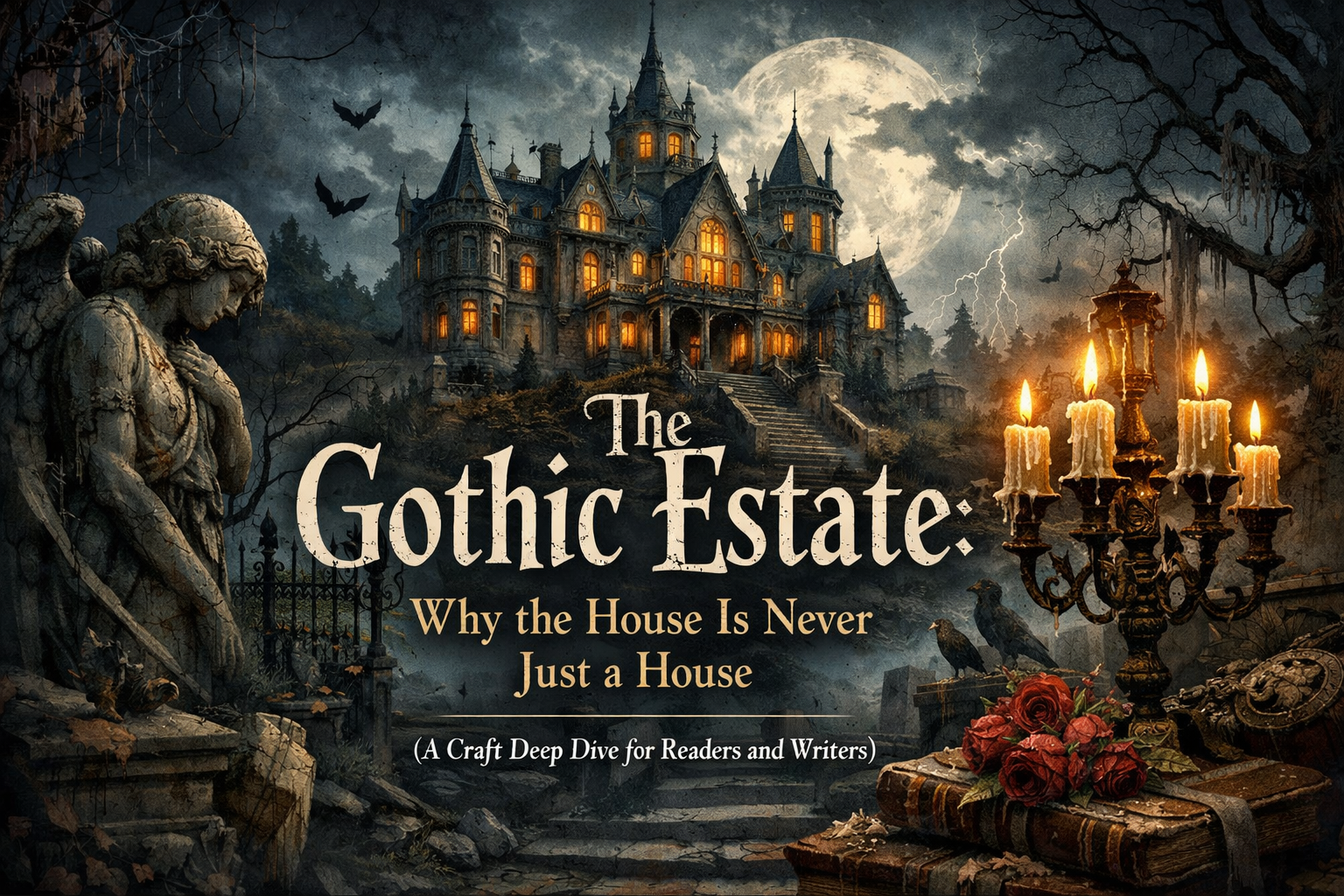
I need to tell you something about myself that will surprise no one who has ever seen my bookshelves: I am a sucker for a big, old, crumbling, emotionally unstable house.
The manor on the hill. The estate at the end of the long gravel drive. The château with the locked east wing. The house that knows more than it’s saying — and it is always saying something, if you know how to listen.
In gothic fiction, the house is never just a setting. It’s memory. It’s inheritance. It’s family secrets with load-bearing walls. And the writers who understand this — the ones who build their houses with the same care they give their characters — produce some of the most extraordinary prose in the English language.
I’m an English major at heart. I teach. I write gothic novels of my own. And I believe that one of the best ways to become a better reader — and a better writer — is to slow down, look at a single passage, and ask: why does this work? What is the author doing with sentence structure, word choice, rhythm, and implication that makes you feel something before you even understand what you’re feeling?
So that’s what we’re doing today. We’re going to walk through some of the greatest house descriptions in gothic literature — from the 1830s to last year — and I’m going to show you, line by line, what makes them extraordinary. Not just as atmosphere. As craft.
1. The House That Thinks
The Haunting of Hill House by Shirley Jackson (1959)
“No live organism can continue for long to exist sanely under conditions of absolute reality; even larks and katydids are supposed, by some, to dream. Hill House, not sane, stood by itself against its hills, holding darkness within.”
This is arguably the most famous opening in horror fiction, and it deserves every ounce of its reputation. But I want you to look at it not as a reader — look at it as a writer. Look at what Jackson is doing with structure.
She opens with a universal philosophical statement: no living thing can exist sanely in pure reality. Everything dreams. You nod along. Sure, that makes sense. Larks dream. Katydids dream. The sentence has a gentle, almost lulling rhythm.
And then the pivot: “Hill House, not sane.”
She has just slipped the house into the category of living organism without ever stating it directly. She built a grammatical pattern — living things dream; living things can lose their sanity — and dropped the house into that pattern as though it belonged there. By the time you reach “holding darkness within,” your brain has already accepted that Hill House has a mind. That it’s ill. That it dreams. She didn’t argue for it. She didn’t explain. She structured the sentence so your mind made the leap on its own.
That’s not description. That is manipulation. And it’s the first paragraph of the book.
✎ Craft lesson: Implication through syntax. Jackson never writes “the house was alive.” She builds a grammatical pattern and lets parallelism do the arguing. If you want your reader to believe something uncanny, don’t state it. Build a sentence where the only logical conclusion is the uncanny thing — and let the reader arrive there on their own.
2. The Way Was Barred
Rebecca by Daphne du Maurier (1938)
“Last night I dreamt I went to Manderley again. It seemed to me I stood by the iron gate leading to the drive, and for a while I could not enter, for the way was barred to me.”
Two sentences. That’s all it takes. And du Maurier has already told you this woman’s entire emotional life.
Look at the word choice: “The way was barred to me.” Not locked. Not blocked. Barred. And she never tells you who barred it. There’s no lock, no gatekeeper, no person standing in the way. The sentence is passive — the way was barred — as if Manderley itself decided she doesn’t get to come home.
And that word, “seemed.” “It seemed to me I stood by the gate.” She’s not even sure she was there. This is a woman so haunted by a house that she dreams about it, and even in the dream, even in her own unconscious, the house says no.
Most writers are told to avoid passive voice. Du Maurier weaponized it. When you remove the actor from a sentence, you give the action to the atmosphere. Nobody locked the gate. The place did. And that’s worse. That’s always worse.
Two sentences, and she’s told you everything: a woman exiled from a house that was never really hers, dreaming her way back to a door that won’t open. The whole novel is right there in the opening. Du Maurier didn’t need a prologue. She needed twenty-seven words.
✎ Craft lesson: Passive voice as a gothic weapon. We’re taught to avoid it, but in gothic fiction, removing the actor from a sentence gives the action to the place. “The way was barred to me” is more unsettling than “someone barred the way” precisely because there’s no agent. The house did it. And you can’t argue with a house.
3. The House That Defeats Language
The Fall of the House of Usher by Edgar Allan Poe (1839)
“I looked upon the scene before me — upon the mere house, and the simple landscape features of the domain — upon the bleak walls — upon the vacant eye-like windows — upon a few rank sedges — and upon a few white trunks of decayed trees — with an utter depression of soul which I can no more liken to no earthly sensation than to the after-dream of the reveller upon opium.”
Count the dashes. Six of them. The narrator keeps interrupting himself. He’s trying to describe what he sees, and he can’t land anywhere — walls, windows, weeds, trees — his eye keeps jumping from one detail to the next, and each one makes the feeling worse, but none of them individually explains it.
That repetition — “upon… upon… upon…” — is not a list. It’s a man losing control of his own sentence. He came to the House of Usher educated and articulate, and the house is dismantling his ability to describe it.
And watch what he slips in, almost involuntarily: “the vacant eye-like windows.” He’s trying to be rational and objective, and his own language betrays him. The house is staring back at him, and he just told you that without realizing he said it.
Then the finish. He doesn’t compare the feeling to fear. He compares it to “the after-dream of the reveller upon opium.” Not terror. Withdrawal. The absence of something. The house doesn’t frighten him. It empties him. It’s the feeling after the feeling — the place where language goes and doesn’t come back.
✎ Craft lesson: The failure to describe as a narrative tool. Most writers think the goal is to describe something perfectly. Poe understood something harder: sometimes the most powerful thing your narrator can do is reach for the words and miss. Repetitive syntax (“upon… upon… upon…”) builds accumulation and weight. And when an educated narrator fails to articulate his own dread, the failure itself becomes the horror.
4. The Corridor That Tells the Future
Jane Eyre by Charlotte Brontë (1847)
“I lingered in the long passage to which this led, separating the front and back rooms of the third storey: narrow, low, and dim, with only one little window at the far end, and looking, with its two rows of small black doors all shut, like a corridor in some Bluebeard’s castle.”
On the surface, this is just Jane describing a hallway. Narrow, low, dim, one small window, two rows of closed doors. Architectural details. Nothing supernatural. Nothing overtly threatening.
And then: “like a corridor in some Bluebeard’s castle.”
Bluebeard. The fairy tale about the husband who keeps his murdered wives in a locked room. Jane drops this reference casually, almost playfully, as though it’s just a funny comparison that popped into her head. She doesn’t dwell on it. She moves on.
But the reader’s unconscious does the math: locked doors. A husband with secrets. Something terrible hidden in this hallway. Brontë is foreshadowing the entire plot of the novel in a simile that Jane herself doesn’t fully understand yet. The character is being witty. The author is being prophetic. Those two layers operating simultaneously — the character’s innocence and the author’s knowledge — is extraordinary craft.
And notice the physical details: “narrow, low, and dim.” The hallway is compressing around Jane. “Two rows of small black doors all shut.” Every door is closed. Every door is a secret. The architecture is doing what Rochester won’t: telling Jane that something in this house does not want to be found.
✎ Craft lesson: Literary allusion as compressed storytelling. One reference to Bluebeard does the work of pages of foreshadowing. And when your narrator uses a metaphor they don’t fully grasp the implications of, you create dramatic irony — the reader knows more than the character, and that gap is where suspense lives.
5. The Narrator Who Is the House
We Have Always Lived in the Castle by Shirley Jackson (1962)
“My name is Mary Katherine Blackwood. I am eighteen years old, and I live with my sister Constance. I have often thought that with any luck at all I could have been born a werewolf, because the two middle fingers on both my hands are the same length, but I have had to be content with what I had. I dislike washing myself, and dogs, and noise. I like my sister Constance, and Richard Plantagenet, and Amanita phalloides, the death-cap mushroom.”
This isn’t a house description in the traditional sense. It’s something more unsettling: it’s the narrator becoming the house.
Merricat Blackwood is the Blackwood house in human form: isolated, strange, full of buried poison, and utterly matter-of-fact about all of it. Jackson buries “Amanita phalloides, the death-cap mushroom” at the end of a list that includes her sister and a historical figure, delivered in the same casual, declarative tone. She likes three things. One of them kills people. She doesn’t explain. She doesn’t flinch.
The Blackwood house is eventually burned and wrecked by the townspeople, and Merricat and Constance simply keep living in it — because what is a gothic house except a place where terrible people feel perfectly at home? Jackson understood that the house and the inhabitant are the same sentence. The ruin outside mirrors the ruin inside. The isolation of the estate is the isolation of the mind living in it.
✎ Craft lesson: Tone is characterization. Merricat’s flat, declarative syntax tells you everything about her before the plot even starts. If your narrator describes monstrous things in a calm voice, the reader feels the monstrousness more, not less. The dissonance between content and delivery is where the chill lives.
6. The House That Eats
Mexican Gothic by Silvia Moreno-Garcia (2020)
Every gothic novel on this list uses the house as a metaphor. Moreno-Garcia took the metaphor and made it literal.
High Place, the Doyle family estate in Mexican Gothic, is not haunted in the traditional sense. It’s biological. The house is connected to a fungal network that binds the family to the building itself. The walls have a pulse. The gloom has a texture. The mold creeping through the corridors isn’t decay — it’s digestion. The house is eating the people inside it, and the family has been feeding it for generations.
What Moreno-Garcia understood is that the gothic house metaphor — the house as body, the house as family, the house as memory — had been operating for two hundred years, and it was time to stop being coy about it. High Place doesn’t represent the family’s parasitic relationship with the land and its people. It is that relationship, made fungal and architectural and horrifyingly real.
This is also a novel that explicitly engages with colonialism — the Doyles are English colonizers in Mexico, and the house is built on extraction in every sense. The gothic estate as a monument to inherited power and inherited violence is not a new idea, but Moreno-Garcia made it visceral in a way the genre hadn’t seen before.
✎ Craft lesson: When you’re working within a genre tradition, ask yourself: what has always been metaphor that could become literal? Moreno-Garcia didn’t abandon the gothic house tradition. She honored it by taking it to its most extreme, most honest conclusion. The house doesn’t represent something. The house IS something. That’s how you make an old genre feel new.
7. The House with a Personality Disorder
Beloved by Toni Morrison (1987)
“124 was spiteful. Full of a baby’s venom.”
Seven words. Toni Morrison opens her novel with a house number and a personality trait. Not “124 Bluestone Road was a difficult place to live.” Not “the house at 124 had a troubled history.” The house was spiteful. The house had venom. The house had the emotional character of an infant — pure, unfocused rage.
Morrison doesn’t give you the courtesy of a full address. Just the number. 124. As though everyone already knows which house this is. As though its reputation precedes it. And then she gives it a diagnosis in three words: spiteful, full, venom.
This is a haunted house novel, but it’s also a novel about the haunting of an entire nation — about what slavery did to the people who survived it, and about the ways trauma doesn’t stay in the past. The house is the vessel for that truth. 124 doesn’t just contain a ghost. It contains history, and history in this novel is not abstract. It throws things. It leaves handprints. It moves furniture. It will not be ignored.
✎ Craft lesson: Economy of language. Morrison uses seven words to do what other writers need seven pages for. “124 was spiteful” gives the house a number (identity), a verb of being (existence), and an emotional state (character) in a single sentence. If you can give your setting a personality in one line, you’ve done something most writers never achieve.
The House Lives On
This tradition — the house as character, as body, as psychological portrait — isn’t historical. It’s alive and thriving. Every year, new gothic novels appear with new houses that know too much, and the best of them understand that the estate is never decoration. It’s the novel’s beating, rotten heart.
I know this because I write them. My houses are as much characters as my people are, and every one of them learned something from the masters we’ve studied today.
Château d’Allard in House of Mischief is a crumbling French château in Burgundy surrounded by lavender meadows, with candlelit ballrooms and haunted towers and an ancient pagan god sleeping somewhere beneath the foundation. It’s beautiful and theatrical and hiding something in the basement, a house that seduces you with its charm before it shows you what it’s been keeping in the dark. That’s du Maurier’s trick: the gorgeous surface concealing something unforgivable underneath.
Sungrove, in the Song of the Seasons series, is the kind of estate that looks like it’s welcoming you while it’s actually trapping you. It’s an enchanted fae manor where the illusions are so beautiful you don’t realize you’ve been captured until the doors won’t open. That’s Moreno-Garcia’s lesson in action, the house that consumes you while you’re still admiring the wallpaper.
In The Second Chance Villa, the Lake Garda villa has crumbling frescoes, terraced olive groves, and the sun-bleached warmth of a place that wants you to forget what happened here. The restoration work — peeling back layers of plaster and paint — mirrors the characters peeling back years of silence and estrangement. The house heals as they heal. That’s Poe’s insight inverted: instead of the house reflecting decay, it reflects the slow, painful work of repair.
And Thornwood Hall in Under the Unquiet Moon is an ancient Tudor manor in Essex with dark timber and leaded windows that catch the afternoon light and return it softened and filtered through age. It is, as the narrator discovers, “not between worlds — it was what happened when two worlds had never properly agreed to separate.” That line is doing exactly what Jackson taught us: it doesn’t tell you the house is magical. It tells you the house exists in a state that makes magic the only logical conclusion. Thornwood Hall’s companion, Ashwyn House in Mayfair, takes it further still, a house with a spirit that accepts you at the threshold, where doors open without protest and corridors make room for you, and the whole place holds its breath when you bring something strange through the front door.
I learned how to write these houses from Jackson and du Maurier and Brontë and Poe and Morrison and Moreno-Garcia. I learned by doing exactly what we’ve done in this post: slowing down, reading one line at a time, and asking how did they do that?
That question — how did they do that — is the beginning of craft. It’s the beginning of critical thinking. It’s the difference between reading a book and understanding a book. And it’s available to everyone, not just English majors. You just have to slow down long enough to listen to what the sentence is actually doing.
What This Post Is Really About
I could talk about gothic houses for hours — and I frequently do, to anyone who will listen and several people who won’t. But what I’m really talking about, underneath all the crumbling manors and fungal walls and spiteful house numbers, is the power of close reading.
We live in a world that moves fast. We consume content in seconds. We scroll, we skim, we move on. And there’s nothing wrong with that — but there’s something extraordinary that happens when you stop, take a single sentence, and ask: what is this doing to me, and how?
Jackson manipulated your brain with syntax. Du Maurier weaponized passive voice. Poe built dread through the failure of language. Brontë hid the entire plot in a fairy tale reference. Jackson (again) turned a narrator into a house. Moreno-Garcia made the metaphor literal. Morrison gave a house number a personality disorder in seven words.
Seven writers. Seven houses. Seven completely different lessons in how to make a place feel alive on the page.
That’s not just gothic fiction. That’s craft. That’s the kind of deep, careful, critical thinking the world needs more of. And it starts with one line and the willingness to ask: why is this so good?
Tell me your favorite gothic house in the comments. I want to know which fictional estate lives rent-free in your brain.