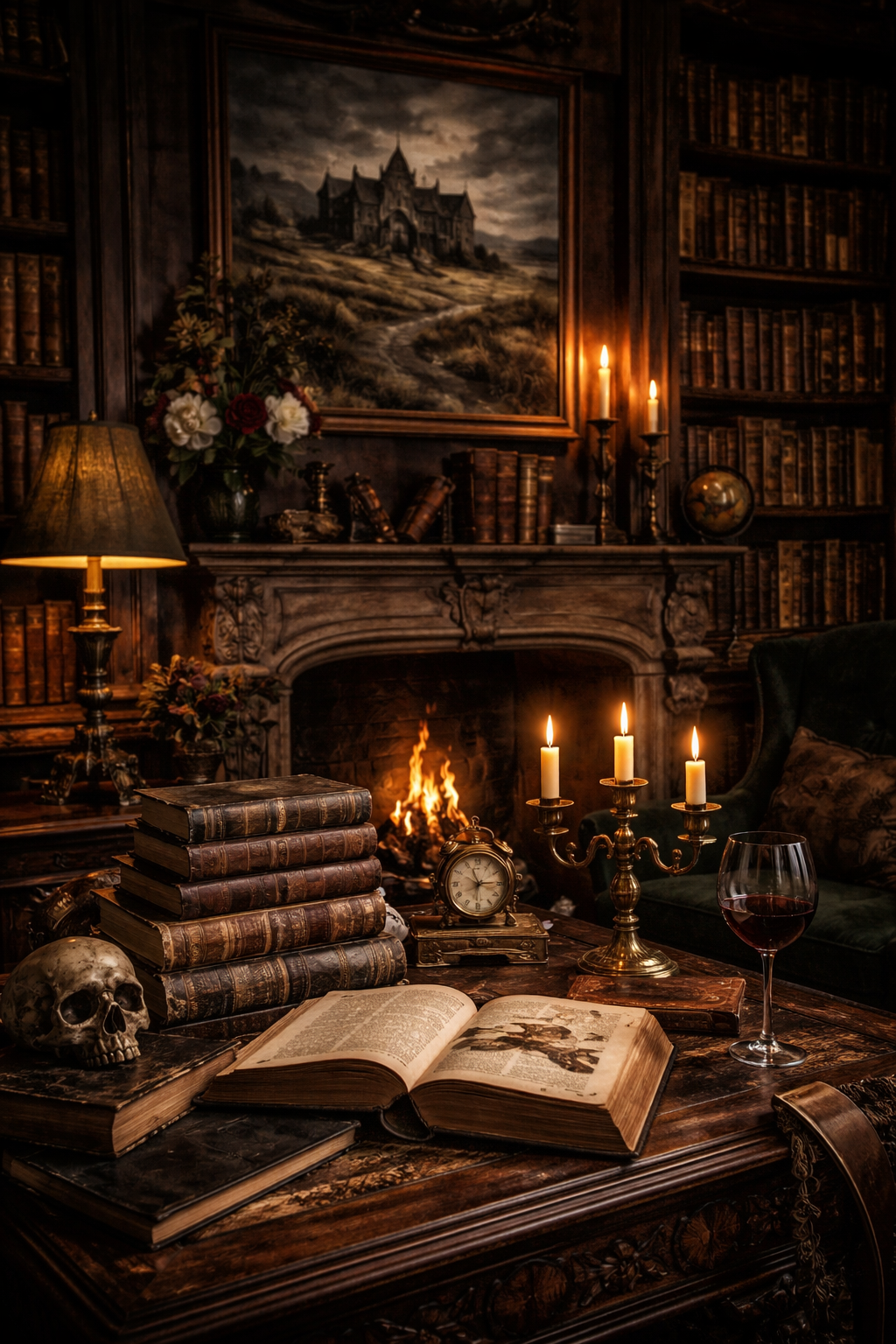
Every April, I want to celebrate one of my favorite literary traditions in the world: the gothic novel.
I have a degree in English literature, and gothic fiction has been one of my great reading loves for as long as I can remember. It is the genre I return to when I want beauty with teeth, atmosphere with meaning, and stories that understand how terror often lives inside ordinary structures of power. I write in that tradition, too. House of Mischief, Daughter of the Tempest Born, and my current work-in-progress, All That Was Promised, all carry that same love of the haunted, the uncanny, the emotionally charged, and the darkly beautiful.
So this month, I’m leaning in. April is for all things gothic novel.
The gothic has always been more than ruined houses, candlelight, storms, and things that go bump in the night. Yes, it gives us crumbling estates, dangerous secrets, doubles, ghosts, locked rooms, wild landscapes, and strange inheritances. But the reason it endures is that it has always understood something deeper: sometimes the real horror is not the monster in the cellar. It is control. Confinement. Silencing. Surveillance. Marriage as entrapment. Family as prison. Respectability as a weapon.
That is one reason the gothic has been such a powerful space for women writers and women readers. The genre first emerged in the eighteenth century, with Horace Walpole often credited as an early founder, and it reached its first major wave of popularity in the 1790s. Ann Radcliffe became one of its defining voices, helping shape the form through novels like The Mysteries of Udolpho and The Italian, both of which centered atmosphere, suspense, and female experience in ways that changed the genre for good. Later, writers such as Mary Shelley and the Brontës would bend the gothic into even stranger, sharper, more emotionally dangerous forms.
And it matters to me that so much of this tradition runs through women. Emily Brontë published Wuthering Heights in 1847 under the name Ellis Bell; she and her sisters used masculine pen names in a literary culture that did not greet women’s work with fairness. That fact alone tells you something about why the gothic became such fertile ground for female anger, female imagination, and female resistance. When women could not always speak openly, they wrote locked rooms, madwomen, violent weather, dangerous men, inheritance battles, and haunted houses. They wrote terror as metaphor, and sometimes not even as metaphor at all.
That is also why the gothic feels so alive again right now. In the current political atmosphere in the United States, I find myself returning to gothic literature with renewed urgency. These novels have always known how to dramatize the threats women live with: the pressure to obey, the theft of autonomy, the narrowing of possibility, the punishment for refusing to submit. The genius of the gothic is that it rarely preaches. It embodies. It gives those forces a house, a marriage, a family line, a corridor, a storm, a law, a body. And yet, for all the weirdness and doom and melodrama, gothic heroines so often survive. They endure. They uncover. They escape. They speak. Sometimes they even burn the whole edifice down.
Part of why this feels especially timely is that gothic storytelling is plainly back in the cultural conversation. Emerald Fennell’s Wuthering Heights opened on February 13, 2026, and the response was sharply divided: some viewers and critics praised its boldness and visual excess, while others bristled at its liberties with Emily Brontë’s novel. I honestly expected to dislike it, and then ended up liking it very much. No, it was not the Wuthering Heights Emily Brontë wrote. But I thought it captured something real about the book’s fever, obsession, sensuality, and emotional extremity, and I found it visually stunning. Also, in a sentence I did not expect to type this year, I have had the Charli XCX soundtrack in heavy rotation since I saw the movie with my husband over Valentine’s Day weekend.
That tension, honestly, is gothic in itself. The genre has always invited argument. What counts as faithful? What counts as excessive? How much wildness is too much? That split reaction to Fennell’s film feels less like a failure of adaptation and more like proof that gothic literature still has the power to provoke, seduce, unsettle, and divide an audience.
If you are new to the genre, there are so many classic entry points worth exploring: Ann Radcliffe’s The Mysteries of Udolpho, Mary Shelley’s Frankenstein, Charlotte Brontë’s Jane Eyre, and of course Emily Brontë’s Wuthering Heights. And if you want to see how gothic fiction keeps evolving, modern novels like Silvia Moreno-Garcia’s Mexican Gothic prove the form is nowhere near exhausted. It still has plenty to say, especially when it comes to power, gender, family, history, class, violence, and the stories societies try to bury.
So all month long, I’m celebrating the gothic novel here. We’re going to talk about the genre’s history, its key themes, its feminist inheritance, its enduring obsessions, and the reasons it keeps roaring back whenever the world gets especially sharp-edged and strange. And to kick things off, I’ve put together a downloadable guide on gothic writing techniques, plot devices, and story elements for writers, readers, and BookTok lovers who want to sink deeper into the dark.
Welcome to Gothic April. Let’s go wander the corridor.
Looking for more on Gothic Novel plot devices? Go here for 15 common gothic novel writing techniques: Gothic Novel Plot Devices.